Tag Play: The Typeface That Brings Street Art Energy to Your Designs
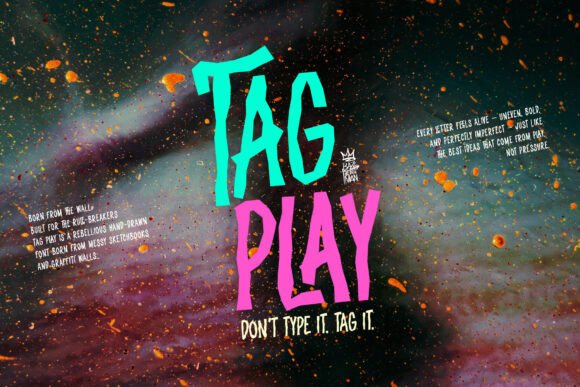
Some fonts sit quietly on the page, doing their job without making a fuss. Then there are typefaces that crash through the door, shake up the room, and demand attention. Tag Play belongs firmly in the second category. This bold, hand-drawn display font channels the raw energy of street graffiti, the kind you'd spot on a downtown wall or splashed across a skate deck. Every letter feels alive, built with dynamic brush strokes that carry a sense of movement and creative rebellion. If your project needs a jolt of urban attitude, this typeface delivers it without hesitation.
What Makes This Typeface Stand Out
Tag Play draws its personality from graffiti culture, where imperfection is a feature, not a flaw. The letterforms are intentionally rough around the edges, mimicking the look of markers, spray cans, and hand-painted signage. Each character carries its own weight and rhythm, which gives text a kinetic quality that polished, geometric fonts simply cannot replicate. There is a looseness here that feels authentic, like someone grabbed a brush and let instinct take over.
This kind of visual character works especially well when you want your design to feel approachable, energetic, and youthful. It avoids the stiffness of corporate typography and instead speaks a language that resonates with streetwear brands, music artists, fitness communities, and anyone targeting an audience that values authenticity over perfection.
Creative Projects That Come Alive With Tag Play
Think about the designs you encounter every day that rely on bold, expressive lettering. Album covers for hip-hop and punk artists. Event posters for music festivals and underground shows. YouTube thumbnails that need to pop in a crowded feed. Streetwear logos and merch graphics. Sports team branding. The common thread is that these projects need typography that communicates attitude and energy at a glance. Tag Play fits naturally into all of these contexts.
Beyond the obvious urban and music-related applications, this typeface also works surprisingly well in less expected places. Packaging for craft beverages, artisan snacks, or youth-oriented consumer goods can benefit from its handcrafted feel. Social media graphics for fitness coaches, DJs, or lifestyle influencers gain an instant visual edge. Even invitation designs for casual events, backyard parties, or creative workshops can use this font to set a relaxed, fun tone from the start.
Pairing Tag Play With Other Fonts
A display font this expressive needs careful pairing to maintain readability and visual balance. The general principle is straightforward: let Tag Play handle the headlines and short bursts of text where its personality can shine, then pair it with a cleaner companion for body copy. A simple sans serif font works well here. Something like a modern sans serif with generous spacing gives the reader's eye a rest after the visual intensity of the headline.
For example, imagine a concert poster. Tag Play handles the artist name and event title, large and commanding. Below it, a clean sans serif provides the date, venue, and ticket details in a calm, legible style. The contrast between the two creates visual hierarchy naturally. The headline grabs attention, and the supporting text does its job without competing.
Script fonts can also work as a secondary pairing in certain contexts, particularly when you want to add a touch of elegance or personality to supporting text. The key is to avoid pairing Tag Play with another highly decorative or hand-drawn font, as this creates visual chaos rather than contrast.
Readability and Practical Considerations
Any designer worth their salt will tell you that a font's visual appeal means nothing if people cannot read it. Tag Play is a display typeface, which means it is designed for large-scale use. Think headlines, logos, banners, and short phrases. It is not the right choice for long paragraphs or small body text, where its textured, brush-style letterforms would become difficult to parse at smaller sizes.
Keep this in mind when planning your layouts. Use Tag Play where it will be seen at a size that allows its details to register clearly. Test it across different media. A font that looks fantastic on a poster printed at 24 inches might lose its impact when scaled down for a business card. Always preview your work at the actual output size before committing to a final design.
Color also plays a role. Because Tag Play has a strong visual texture, it tends to look best when set against clean, uncluttered backgrounds. A solid color backdrop or a subtle gradient lets the letterforms breathe. Busy photographic backgrounds can muddy the details and reduce legibility, so use caution or consider adding a semi-transparent overlay behind the text.
Building Brand Identity With Expressive Typography
Typography is one of the most powerful tools in a brand identity toolkit. The fonts you choose communicate volumes about your brand's personality before a single word is read. Tag Play signals creativity, confidence, and a willingness to break from convention. For a streetwear label, a skate brand, an independent music label, or a youth-focused fitness studio, this typeface can become a cornerstone of the visual identity.
Consistency matters here. Once you adopt a typeface as part of your brand, use it across all relevant touchpoints. Social media graphics, website headers, packaging, printed materials, merchandise. When your audience sees that distinctive hand-drawn lettering repeatedly, it becomes associated with your brand. Over time, they recognize it instantly, even without your logo present. That is the power of strong typographic branding.
Small business owners and creative entrepreneurs often underestimate how much a cohesive font choice contributes to professional presentation. Using a premium font like Tag Play, rather than relying on overused free alternatives, signals that you take your craft seriously. It shows attention to detail and a commitment to quality that customers and clients notice, even if they cannot articulate exactly what feels different about your materials.
Licensing and File Formats
Before downloading any creative font for commercial use, always review the licensing terms carefully. Most premium fonts come with specific agreements about how they can be used. Some licenses cover personal projects only, while others allow commercial use across print, digital, and merchandise. If you plan to use Tag Play on products for sale, in client work, or across branded marketing assets, make sure the license you purchase covers those applications.
It is also worth checking what file formats are included. A well-structured font package typically offers multiple formats to ensure compatibility across different design software and platforms. Having access to web font formats is especially useful if you plan to use the typeface on your website, as this ensures consistent rendering across browsers and devices.
Making the Most of Your Design Assets
A great typeface is only as effective as the design decisions surrounding it. Take time to experiment with scale, spacing, and color combinations. Try setting a headline in Tag Play at different sizes to find the sweet spot where its texture reads clearly without overwhelming the layout. Play with letter spacing. Sometimes tightening the tracking slightly gives the text a more cohesive, punchy appearance. Other times, opening it up creates breathing room that feels intentional and modern.
The best results come from treating typography as an active design element rather than an afterthought. When a font like Tag Play is given room to perform, it transforms ordinary compositions into something memorable. Whether you are designing a single social media post or building out an entire brand identity, choosing the right display font sets the tone for everything that follows.